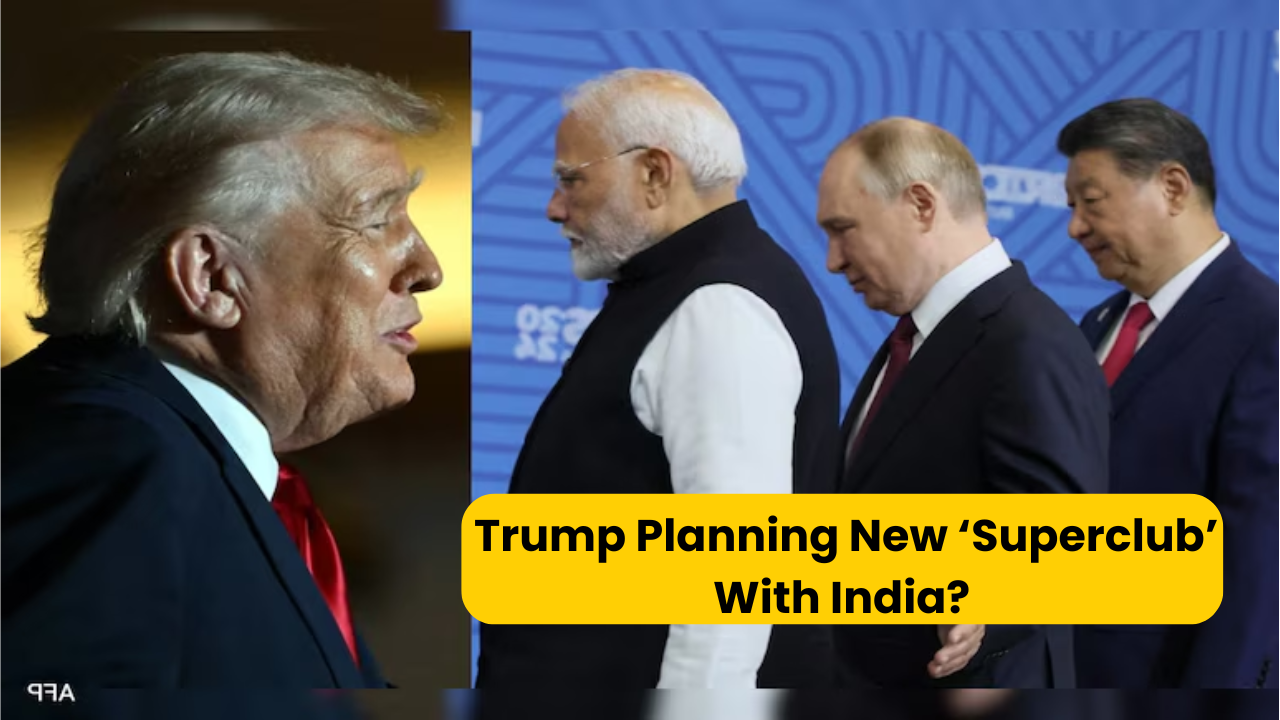
A new idea is making noise in Washington and across global capitals: the possibility of a powerful new international bloc that would sit above traditional Western groups like the G7. According to reports, US President Donald Trump is considering the formation of a “Core Five,” or C5, a strategic partnership between the United States, Russia, China, India, and Japan. The goal, as described in early leaks, is to create a body of major powers without the restrictions of the G7, which requires members to be both wealthy and democratic.
Although nothing about this proposal has been publicly confirmed, the discussion has already sparked debates about what such a group could mean for the world order — and for America’s allies who may find themselves sidelined.
Where Did the C5 Idea Come From?
The buzz started when Politico reported that an unpublished, longer version of the National Security Strategy (NSS) mentioned this new C5 idea. The White House recently released its official 33-page NSS, but according to some reports, a more detailed draft exists behind closed doors.
Politico said it could not verify the long-form strategy itself, but another outlet, Defense One, also claimed that the “Core Five” appeared in that unpublished version.
If true, the idea would be a huge shift. It would bring together the world’s largest population centers and major military-economic powers, forming a group far different from the ideology-oriented G7. Instead of being based on democracy or wealth, the C5 seems to be based entirely on raw power, population, and geopolitical weight.
One section from the reported document said:
“The strategy proposes a ‘Core Five’ — the United States, China, Russia, India, and Japan. It would meet regularly at summits, similar to the G7, to discuss global issues. The first item on the proposed agenda: security in the Middle East, including the normalization of ties between Israel and Saudi Arabia.”
The White House Response
The White House quickly rejected the claims. Press Secretary Hannah Kelly insisted that there is no secret version of the National Security Strategy and that the only official plan is the public 33-page document.
Even so, national security experts say the idea feels very much in line with Trump’s usual worldview. Trump tends to view foreign policy not through ideology or alliances but through the lens of strong nations dealing directly with other strong nations.
“This lines up with how President Trump sees the world — non-ideological, focused on power, and favoring cooperation among big players who run their own regions,” said Torrey Taussig, who served on the National Security Council under the Biden administration.
She also noted something that Europeans will definitely not appreciate: Europe is nowhere in this Core-5 concept. That alone, she said, would make European governments feel the US is elevating Russia over Europe, giving Moscow more legitimacy as a “regional power.”
And that’s where the concerns really begin.
Why Allies Are Worried
This report comes at a time when American allies are already uncertain about how Trump’s second term will reshape global politics. The C5 idea — even if it never becomes reality — suggests a major shift in how the US might approach global leadership.
For decades, the G7 and the G20 have been the central stages where the world’s big economies and democracies come together to coordinate policy. These structures have kept Western nations, especially Europe, at the heart of global decision-making.
But the C5 would do the opposite. It would place Russia, China, and India at the same table as the United States, possibly giving them equal weight in global negotiations. Many analysts say this could weaken traditional US alliances, reduce Western influence, and create a world order that depends more on deal-making among great powers than on shared values.
Some experts worry that this approach could legitimize authoritarian leaders, especially if the US chooses to cooperate with Russia and China more closely. Others point out that placing Russia on the same level as the US or Japan — while pushing Europe aside — could fracture NATO unity. One analyst even said the move would “formalize spheres of influence,” something Europe deeply fears.
Michael Sobolik, a former national security advisor to Senator Ted Cruz, said the idea marks a big shift from Trump’s earlier China policy. “The first Trump administration was built around the idea of great-power competition, mainly with China,” he said. “This C5 idea is a huge departure from that.”
He added that bringing China into a friendly, cooperative grouping would confuse America’s strategic messaging and make allies nervous.
What Happens Next?
For now, this entire idea remains unconfirmed, and maybe it will stay that way. But even the rumor has started global conversations about how the world order could change in the next four years.
If the C5 becomes real, it would probably be the biggest shake-up of international politics since the Cold War. If it doesn’t, the debate itself still reveals how differently Trump’s second administration might approach global leadership.
Either way, countries are watching closely — especially those who fear they may be left out of the world’s next super-club.