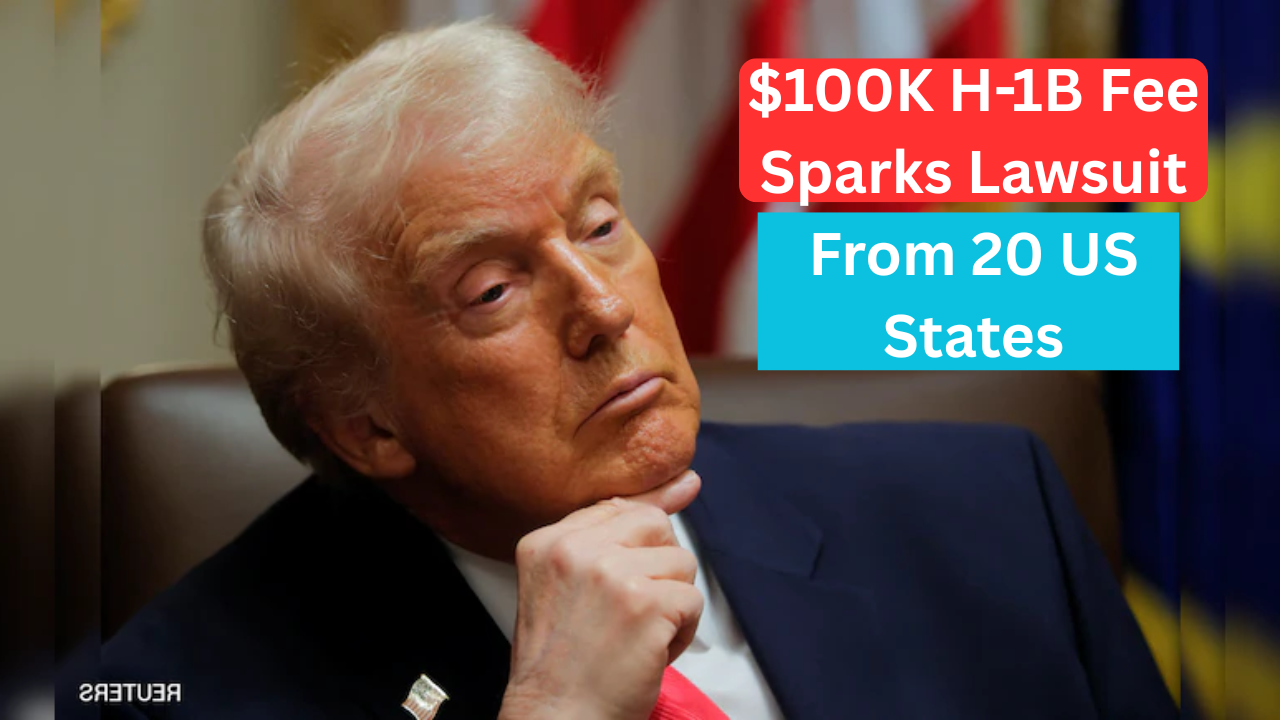
Washington has once again become the center of a major legal and political battle as 20 US states filed a lawsuit against the Trump administration, challenging its decision to impose a massive $100,000 fee on new H-1B visa petitions. The states argue that the policy is unlawful, unconstitutional, and threatens essential public services across the country.
20 US States Sue Trump Over $100,000 H-1B Visa Fee
The lawsuit targets a policy enforced by the Department of Homeland Security (DHS) that dramatically raises the cost for employers hiring skilled foreign workers under the H-1B visa program. This program is widely used by public schools, universities, hospitals, research institutions, and state agencies, making the impact far broader than just private tech companies.
Why the Lawsuit Was Filed
According to the attorneys general, the Trump administration does not have the legal authority to impose such a steep fee without Congressional approval. The states claim the policy violates both the Administrative Procedure Act (APA) and the US Constitution, mainly because it bypasses required rulemaking procedures and exceeds the authority granted to the executive branch.
California Attorney General Rob Bonta, whose office is leading the case, made the state’s position clear.
“As the world’s fourth-largest economy, California knows that when skilled talent from around the world joins our workforce, it drives our state forward,” Bonta said.
He further argued that the $100,000 fee creates unnecessary and illegal financial pressure on public employers who rely heavily on skilled immigrant workers.
“President Trump’s illegal $100,000 H-1B visa fee creates unfair burdens on California public employers and other providers of vital services,” Bonta added, noting that the policy would worsen labor shortages in critical sectors.
How the $100,000 H-1B Fee Was Introduced
President Trump ordered the fee through a presidential proclamation issued on September 19, 2025. DHS applied the new policy to H-1B petitions filed after September 21, granting the Secretary of Homeland Security broad discretion to decide which petitions must pay the fee and which might qualify for exemptions.
This sudden implementation raised immediate concerns among states, employers, and legal experts. Historically, fees tied to the H-1B program have been limited to covering the administrative cost of running the system—not acting as a financial barrier.
At present, employers filing an initial H-1B petition pay between $960 and $7,595, depending on company size, visa category, and compliance requirements. The jump from a few thousand dollars to $100,000 is being described by critics as extreme and unjustified.
Why States Say Public Services Are at Risk
One of the strongest arguments in the lawsuit is that the new fee would directly harm education and healthcare, two sectors already facing severe staffing shortages.
Education Impact
During the 2024–2025 school year, nearly 74% of US school districts reported difficulty filling open positions. The shortages are most severe in:
- Special education
- Physical and natural sciences
- ESL and bilingual education
- Foreign languages
Educators make up the third-largest occupational group among H-1B visa holders, and many public school districts rely on these professionals to maintain classroom standards. The lawsuit argues that forcing schools to pay $100,000 per hire is simply unrealistic.
Healthcare Impact
The healthcare sector may face even greater consequences. In fiscal year 2024, nearly 17,000 H-1B visas were issued for medical and health occupations, with about half going to physicians and surgeons.
According to federal projections, the US could face a shortage of up to 86,000 physicians by 2036. Hospitals, especially in rural and underserved areas, depend heavily on international medical professionals.
State attorneys general argue that the new fee could push hospitals to cancel recruitment plans, delay patient care, or shut down specialized services altogether. That’s not something the system can afford right now.
Legal Arguments Against the Policy
The states claim the Trump administration violated the law in several ways:
- No proper rulemaking process under the Administrative Procedure Act
- Exceeding authority granted by Congress
- Imposing fees unrelated to administrative costs
- Creating arbitrary exemptions without clear guidelines
Federal law requires employers to certify that hiring H-1B workers does not harm US workers’ wages or working conditions. Congress also caps most private-sector H-1B visas at 65,000 per year, with an extra 20,000 visas reserved for applicants with advanced degrees.
Importantly, government and non-profit employers, including universities and hospitals, are generally exempt from these caps—but not from the new fee, which the lawsuit claims is discriminatory and harmful.
Who Filed the Lawsuit
The lawsuit was filed by California Attorney General Rob Bonta and Massachusetts Attorney General Andrea Joy Campbell, joined by attorneys general from:
Arizona, Colorado, Connecticut, Delaware, Hawaii, Illinois, Maryland, Michigan, Minnesota, Nevada, North Carolina, New Jersey, New York, Oregon, Rhode Island, Vermont, Washington, and Wisconsin.
Together, these states represent a massive portion of the US population and economy, adding serious weight to the legal challenge.
Why the H-1B Program Matters So Much
The H-1B visa program is a critical pathway for skilled foreign workers, especially professionals from India, who form a large share of visa holders. These workers are deeply involved in technology, healthcare, engineering, education, and academic research.
The states argue that weakening the H-1B program through extreme fees doesn’t protect American workers—it hurts public services, slows innovation, and weakens global competitiveness. And honestly, that’s a point many economists agree on.
What Happens Next
The lawsuit now moves into the federal court system, where judges will review whether the Trump administration overstepped its authority. If the court issues an injunction, the fee could be paused or blocked entirely.
Until then, employers remain unsure how long the policy will stay in place, and many have already delayed or canceled new H-1B filings. That uncertainty itself is causing damage.
FAQs
Q1: What is the $100,000 H-1B visa fee?
It is a new fee ordered by President Trump that applies to certain new H-1B visa petitions, far higher than existing costs.
Q2: Who filed the lawsuit?
Twenty US states, led by California and Massachusetts, filed the lawsuit against the Trump administration.
Q3: Why are states opposing the fee?
They argue it is illegal, unconstitutional, and would worsen labor shortages in education and healthcare.
Q4: Does the fee apply to schools and hospitals?
Yes, unless exempted by DHS, which is one of the main legal concerns raised.
Q5: How does this affect Indian professionals?
Indian workers make up a large portion of H-1B holders, especially in tech and healthcare, so the impact could be significant.
- Airtel ₹199 Free Data Booster: कम कीमत में Extra Data और Unlimited Calling का Combo

- बड़ी खबर: मोदी जी ने ऐलान किया अब होगा सबका Free में Mobile रिचार्ज Jio की बड़ी खबर

- Refex Industries Shares Crash 20% After Tax Raids and Insider Trading Penalties

- Netflix to Acquire Warner Bros. Studio and Streaming Business for $72 Billion

- $100K H-1B Fee Sparks Lawsuit From 20 US States